LIFE EUROBUSTARD

life eurobustard horizontal white

Bustards
Flagship Birds of Europe’s Steppes

Bustards -
Flagship Birds of Europe’s Steppes

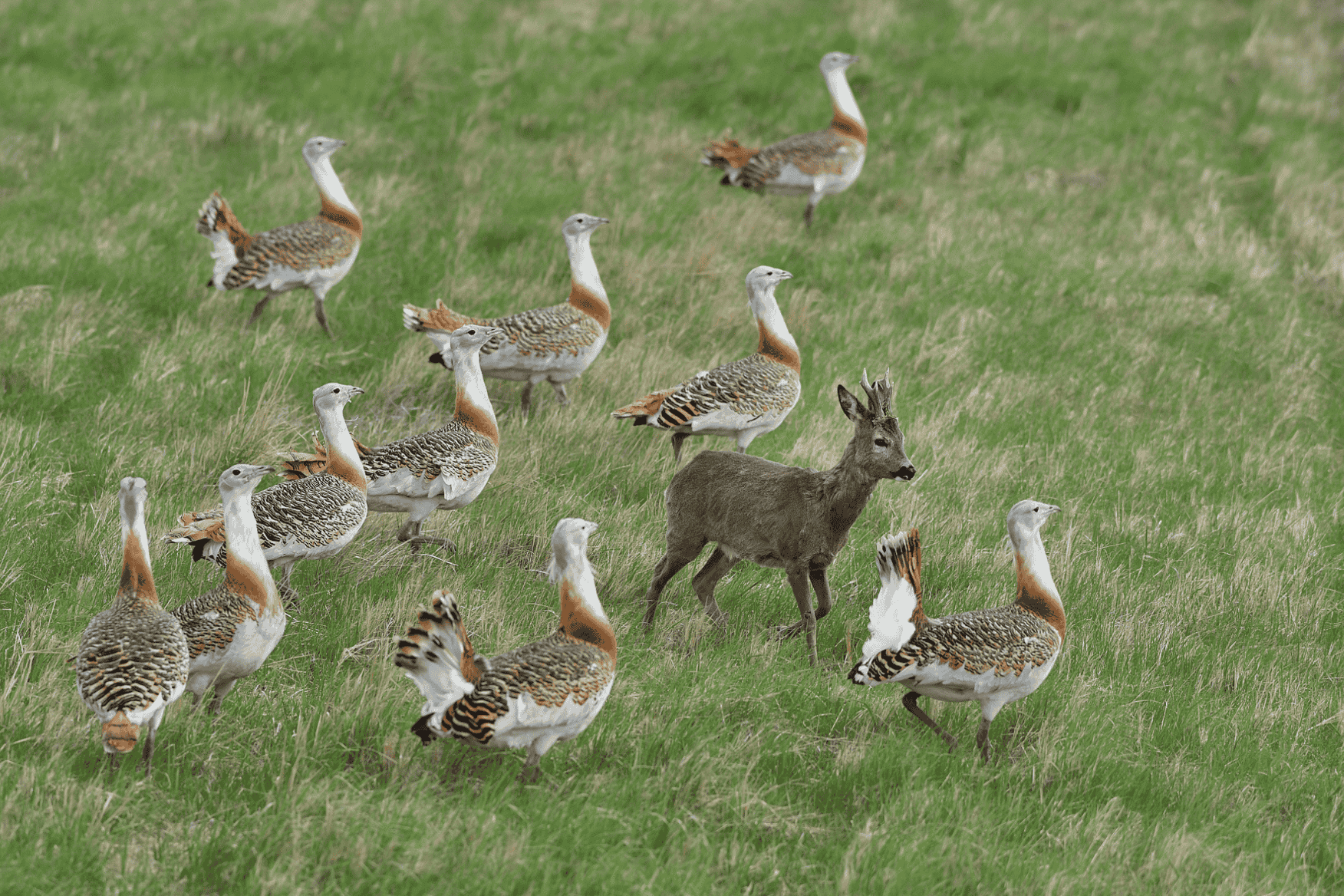
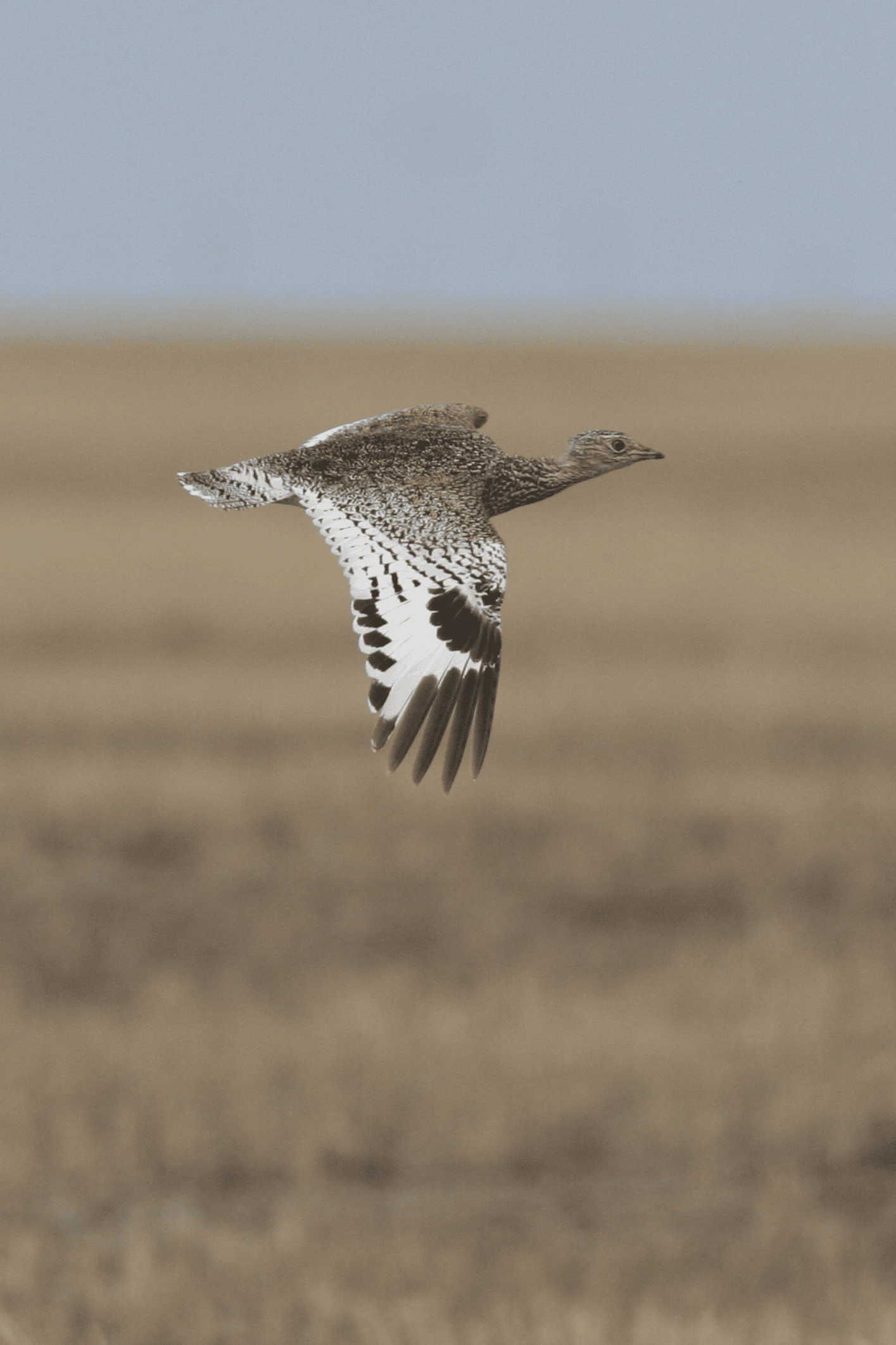
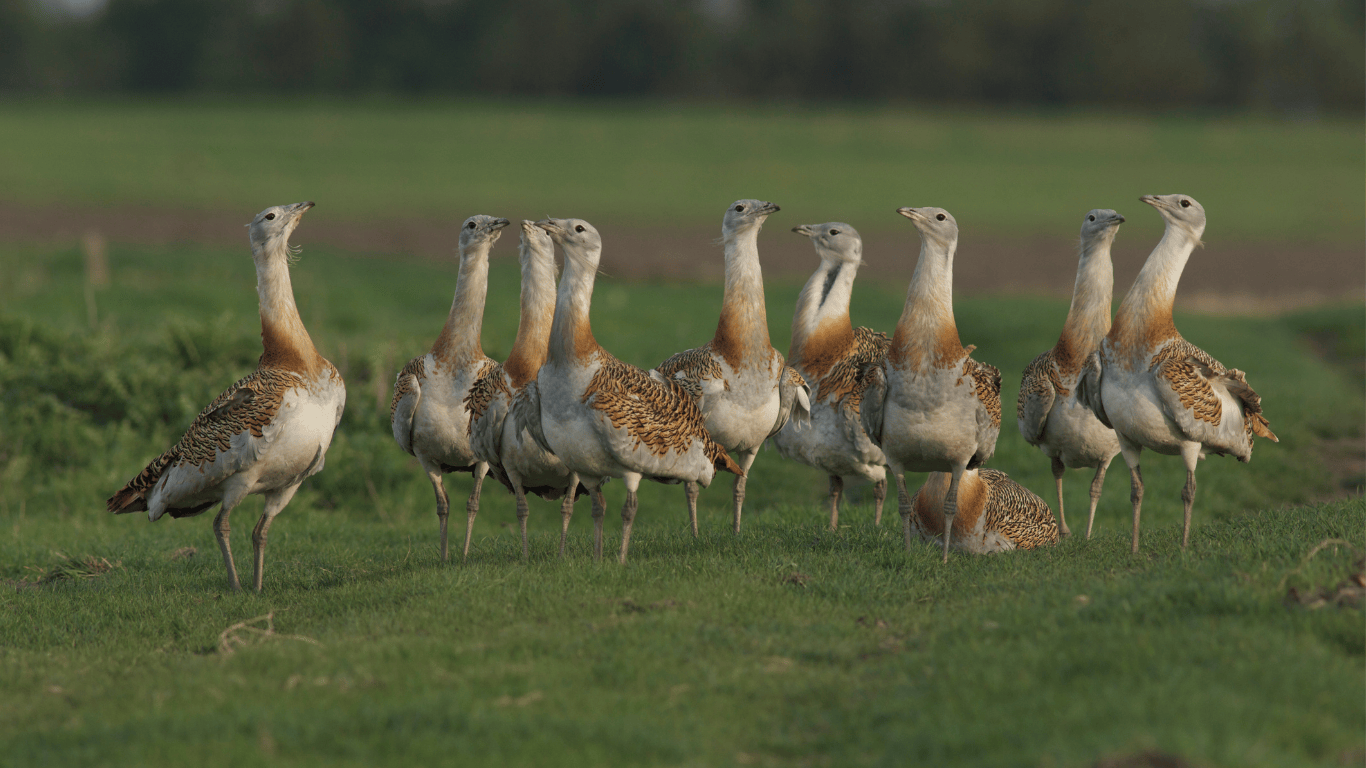
Grassland birds are among the bird groups currently experiencing the steepest population declines. The Great Bustard (Otis tarda) and the Little Bustard (Tetrax tetrax) are particularly at risk.

Previous LIFE projects in Central Europe, coordinated by the ÖGG and implemented by Dr. Rainer Raab and his team from TB Raab Ltd., have shown that the protection of these remarkable birds can be successfully achieved.

Building on over 25 years of experience in Great Bustard conservation, the LIFE EUROBUSTARD project aims to halt the decline of both Great and Little Bustards across Europe. The coordinating beneficiary is the Austrian Society for Great Bustard Conservation (ÖGG).

TB Raab Ltd. oversees the project management and coordinates its implementation together with 29 project partners, 2 co-financiers, and several cooperation partners from eight European countries. Comprehensive conservation measures to ensure the long-term survival of these impressive birds are implemented within the next years.

Important project facts

Project
countries:

Austria, France,
Germany, Hungary, Portugal, Romania, Slovakia, Spain,
(Ukraine)

Project
duration:

88 months

Project
budget:

22,957,555.88 €

EC
Co-funding:

75%

Coordinating beneficiary:

Österreichische Gesellschaft Großtrappenschutz

Number of beneficiaries:

30

Results & Expected Impact

kovacs gbs

Increase in Great Bustard Population

An increase of approximately 367-524 individuals of Great Bustard across the project countries, notably Austria, Germany, Hungary, Portugal, Romania, Slovakia, and Spain.

little bustard

Increase in Little Bustard population

An increase of approximately 1,542 to 2,351 individuals of Little Bustards in France, Spain, and Portugal.

untitled design(27)

Reversing Decline

Importantly, these population increases should not be interpreted in isolation. Without the LIFE EUROBUSTARD intervention, both species would continue their steep decline — likely resulting in functionally extinct or severely fragmented populations across large parts of Europe. The expected population gains thus represent a reversal of a negative trend, not just an incremental growth.

Project objectives

Land purchase
A total of 91 hectares of land in Germany, France, Austria, and Spain is acquired and converted into bustard habitat.

Tagging
A total of 375 bustards (215 Great Bustards and 160 Little Bustards) are fitted with transmitters to track their movements and monitor populations.

Innovative financing models for scaling the obtained results
On 200 hectares, fallow land with vegetation cover and legumes is established using newly developed financing models. Insights gained on public and private support measures provide a basis for steppe bird conservation across Europe. New compensation models from renewable energy projects are tested, and methodologies for biodiversity credits are developed, which can be offset by companies. These approaches will also inform the future development of the Common Agricultural Policy beyond 2027.

Reducing collision risk within project areas
28.6 km of medium-voltage lines are placed underground, 110.8 km of high-voltage lines are marked, and a 1.5 km photovoltaic system is installed along a railway line to reduce the risk of collisions for bustards and other birds.

Habitat management
Farmers advisory for bustard-friendly practices
LIFE EUROBUSTARD develops a guidance framework to support farmers in bustard-friendly management, building on national agri-environmental measures. Existing rural development programmes are reviewed and adapted to ensure the long-term protection of bustard habitats.

Habitat restoration and biodiversity promotion
High-quality habitats are restored on 287 hectares through seed mixtures, structural elements such as hedges, shrubs, and solar ponds, and the planting of legumes.

Clutch rescue
LIFE EUROBUSTARD rescues at least 1,000 clutches and secures around 375 hectares of habitat around breeding sites to protect nesting females and their eggs. In addition, a clutch centre in Spain is established to support the raising and care of bustard chicks.

Information boards
A total of 19 information boards are installed across bustard habitats in all project countries. They provide visitors with direct information about bustards and their habitat requirements, promoting environmentally friendly behaviour.

Construction of information centre and visitor tower
One all season accessible information centre is built in Austria and a visitor tower in Slovakia. Both facilities consolidate knowledge in a central location and allow visitors to engage more deeply with the topic of bustards.

Scientific Publications
At least seven open-access, peer-reviewed publications on Great and Little Bustards are published, contributing to scientific knowledge and informing future conservation efforts.

Conferences
At least six Europe-wide conferences are organized (Wingspan 2026, MoU 2028, Midterm Conference 2028, Wingspan 2030, Wingspan 2032, and Final Conference 2032) to strengthen collaboration and knowledge exchange among stakeholders.

Work Package

WP1

This WP provides the organisational backbone of the project. It ensures effective coordination between all partners, smooth day-to-day management, and compliance with administrative, financial and reporting obligations throughout the project lifetime. This work package also guarantees structured communication with CINEA and the LIFE Monitoring Team and supports the long-term continuity of project outcomes.

T.1.1 Overall project management - Responsible for the general coordination of the project, including planning, partner communication, progress tracking and risk management, ensuring that activities are implemented on time and in line with project objectives.

T.1.2 Accounting - Covers financial management, budgeting, cost control and the preparation of financial documentation required for internal monitoring and external reporting.

T.1.3 Steering Committee - Establishes and operates the Steering Committee, which provides strategic guidance, supports decision-making and monitors overall project performance.

T.1.4 Advisory Board - Involves external experts and stakeholders who offer independent scientific and technical advice, helping to strengthen the quality and relevance of project actions.

T.1.5 Audit - Ensures financial transparency and compliance with contractual and legal requirements through systematic financial verification and auditing procedures.

T.1.6 After-LIFE Plan – Focuses on the development, discussion and final approval of the project’s After-LIFE Plan. This plan defines how key results, actions and structures will be maintained and further developed after the project ends, ensuring long-term sustainability and transferability in line with established LIFE best practices.

T.1.7 Reports - Covers the preparation and submission of all technical and financial reports required by the LIFE programme, providing clear documentation of project progress, achievements and lessons learned.

T.1.8 Organise tagging permits - This task ensures that all legal permits required for tagging Great and Little Bustards are obtained and kept up to date in each participating country.

T.1.9 Database and application for remote monitoring of birds - This task establishes a central database and monitoring system integrating movement data from tagged bustards across Europe. Automated controls and regular checks ensure data quality and timely detection of potential technical issues.
WP2

WP2 focuses on securing key habitats for Great and Little Bustards through land acquisition and compensation mechanisms, ensuring long-term protection, sustainable management and reduced conflict with land use and infrastructure.

T.2.1 Land purchase - This task secures priority breeding, feeding and roosting habitats for bustards through targeted land acquisition in several project countries. Purchased land will be managed for conservation either by project partners or in cooperation with nature authorities and farmers.
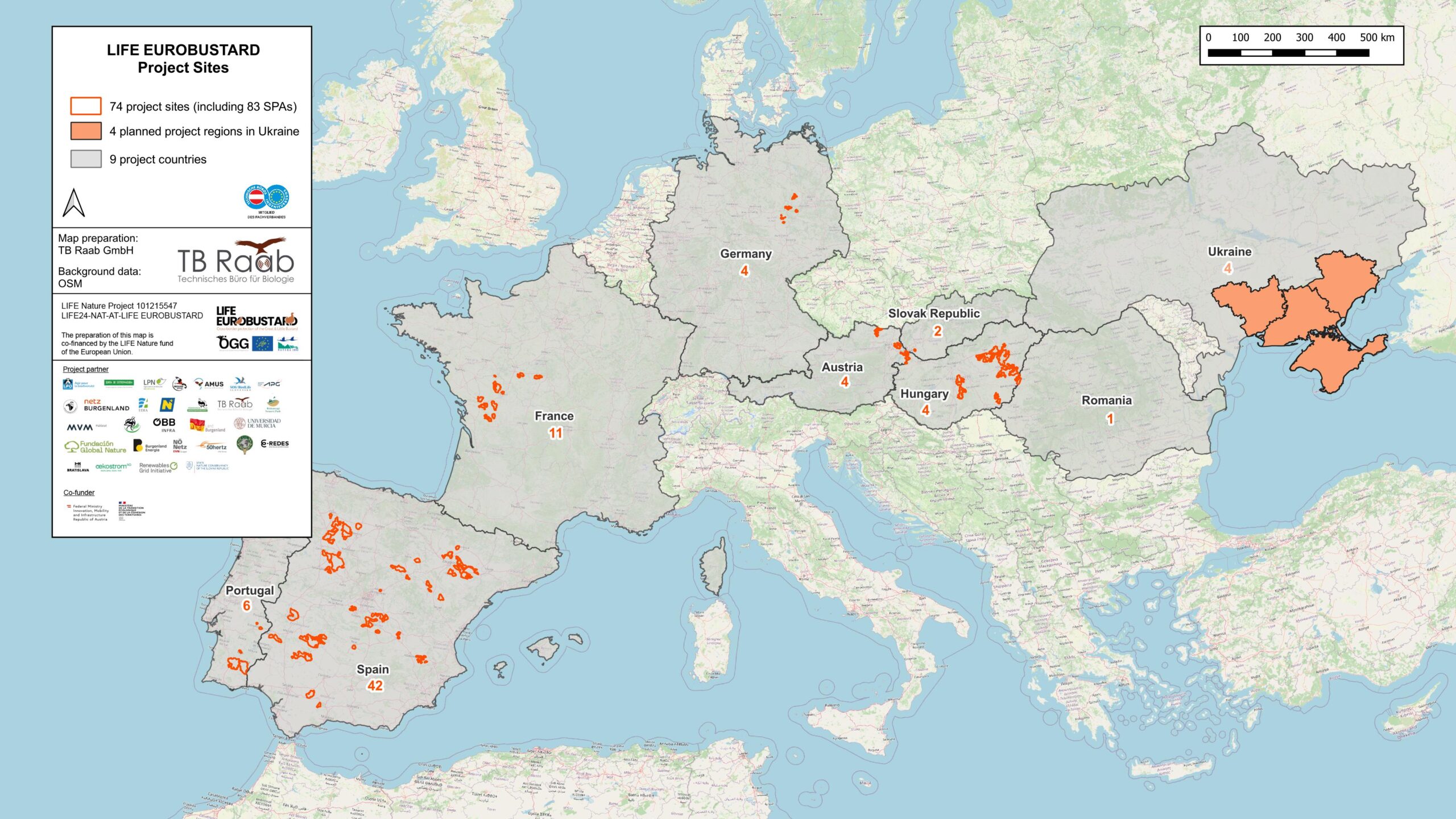
T.2.2 Servitude & compensation payments - This task provides compensation to landowners for conservation-related land use and for infrastructure measures such as underground cabling and power line marking. It also supports agricultural cooperation, including payments for fallow land, habitat-friendly practices and clutch protection during breeding season.

WP3

WP3 focuses on assessing threats and implementing conservation measures to reduce mortality and improve habitat quality.

T.3.1 Tagging - This task equips Great and Little Bustards with GPS transmitters to monitor their movements, habitat use and survival. The collected data supports evidence-based conservation planning and cross-border coordination of protection measures.

T.3.2 Detection of mortality reasons - This task identifies and documents the causes of bustard mortality using tracking data, field observations and laboratory analyses. The results provide a reliable basis for targeting and prioritising mitigation measures against human-induced threats.

T.3.3 Innovative financing models for scaling the results - This task develops innovative funding approaches to support steppe habitat conservation in Spain and beyond. It encourages farmers to maintain ecologically valuable fallow land without economic losses.

T.3.4 Free sky for bustards - This task aims to assess collision risks at key sites in the whole project area, to assess the collision risk of Little Bustards on airfields in France and to exert political influence.

T.3.5 Underground cabling - This task removes high-risk overhead power lines by burying them underground in Austria, Germany, Hungary and Portugal.

T.3.6 Modification of power lines - Within this task, power lines will be marked to reduce bird collisions. Also, new drone-assisted marking methods will be developed and installed.

T.3.7 Pilot project: photovoltaic systems to reduce railway overhead line collisions – Within this task, Photovoltaic systems will be installed along a high-risk railway in Austria to prevent Great Bustard collisions. The barrier is supposed to redirects birds’ flight paths and reduce mortality.

T.3.8 Habitat management - This task maintains open landscapes, structural diversity, fallow fields, and low-intensity farming. Close collaboration with farmers ensures habitats meet bustards’ ecological needs. Proper management prevents habitat loss from abandonment or intensification.

T.3.9 Clutch rescue - Clutches are rescued during breeding season to protect nests from agricultural machinery and predators. Buffer zones and compensation payments safeguard nests across project sites. The goal is to reduce the need for captive rearing as farmer awareness increases.

T.3.10 Update SDF - This task updates the Standard Data Forms (SDF) for Special Protection Areas (SPAs) where Great and Little Bustard populations are outdated. It ensures that population numbers are accurately reflected in official records for better management and conservation decisions across the European SPA networks.

WP4

This WP combines a set of tasks aimed at monitoring, evaluating, and communicating the results and impacts of the project's actions on the resolution of the problems targeted and the achievement of the established LIFE key performance indicators (KPIs). The actions of this WP include fieldwork in the areas to be intervened through conservation measures. These tasks also include the regular collection and assembly of basic operational data on socio-economic and environmental impacts, as well as their processing and comparison with the baseline and the planned objectives.

T.4.1 Impact monitoring of the bustard population in all project areas - The distribution and population of Great and Little Bustards are monitored across all project areas. Fieldwork is conducted year-round with observations recorded on detailed maps. This allows assessment of the effectiveness of implemented conservation measures.

T.4.2 Monitoring of bustard population with satellite tracking & GIS elaboration – Movements and habitat use of tagged birds are analysed using GIS tools. This supports targeted management and protection strategies.

T.4.3 Monitoring the effect of power line marking & underground cabling - This task evaluates how mitigation measures reduce collision risks for bustards and the results support best-practice recommendations for other regions.

T.4.4 Monitoring the effect of habitat management (clutch rescue, …)

T.4.5 Monitoring of socio-economic impacts - This task assesses the social and economic outcomes of conservation measures on local communities and farmers. It evaluates incentives, compensation schemes, and stakeholder engagement. Results help improve collaboration and long-term sustainability.

T.4.6 Monitoring of ecosystem functions - Ecosystem health and function are evaluated in project areas. Indicators include biodiversity, vegetation cover, and habitat quality.

T.4.7 Monitoring of dissemination actions - Social media platforms and the project website are used to share information about bustards and project activities. The reach and impact of these communications are recorded annually within this task.

T.4.8 Monitoring the effect of PV systems on railway overhead line collisions - This task evaluates how the pilot photovoltaic systems reduce collisions of Great Bustards with railway overhead lines. Bird movements and flight behaviour are monitored before and after installation. Results provide evidence on the effectiveness of PV barriers for future mitigation measures.

WP5

The main objectives are to communicate with the public, stakeholders and the media in order to promote and publicise the progress in implementing the project, to provide up-to-date information on its developments and to promote the exchange of technical knowledge with other technical teams.

T.5.1 Website - The project website provides up-to-date information on LIFE EUROBUSTARD activities and results. It serves as a central hub for partners, stakeholders, and the public.

T.5.2 General media work - This task covers media outreach to promote the project and its conservation goals. Press releases, articles, Short videos and interviews raise awareness about bustards.

T.5.3 Promotional material - Printed and digital materials, such as brochures, flyers, and infographics, are created to communicate project results. They support outreach to both the public and stakeholders.

T.5.4 Raising awareness among stakeholders - This task engages farmers, landowners, authorities, and local communities in bustard conservation. Workshops, meetings, and consultations are used to share knowledge and promote best practices. It fosters cooperation and long-term support for project objectives.

T.5.5 Layman’s report - A non-technical report summarises the project’s progress, results, and lessons learned. It is written for a broad audience, including the general public and local communities. The report highlights the ecological and social impact of LIFE EUROBUSTARD.

T.5.6 Information boards - Information boards are installed at key sites to educate visitors about bustards and conservation measures and encourage public interest.

T.5.7 Information centre and visitor tower – This task aims to install one visitor centre and one observation tower to provide a space for environmental education and public engagement and to support long-term awareness and appreciation of local biodiversity.

T.5.8 European bustard coordinator – This task facilitates cooperation and knowledge exchange between bustard experts and institutions across Europe. It supports the improvement of conservation areas and management practices in different countries. Regular communication and expert workshops strengthen coordinated, Europe-wide bustard conservation efforts.

WP6

WP6 ensures that the results of LIFE EUROBUSTARD are scientifically documented, widely shared, and transferred into policy and practice.

T.6.1 Case studies and publications - This task prepares the project’s key results for publication in scientific journals and professional outlets. Findings on power line mitigation, habitat management and population dynamics are made publicly available and accessible via the project website. Policy-relevant summaries support decision-makers and stakeholders across Europe.

T.6.2 Scientific conferences / workshops - This task organises international conferences and national workshops to present project results, exchange expertise and promote best practice.

T.6.3 Networking - This task strengthens European cooperation by linking LIFE EUROBUSTARD with other conservation projects, organisations and stakeholder groups. Knowledge exchange with related LIFE projects, NGOs and species experts supports coordinated action and policy alignment.

Working Together Across Borders

LIFE EUROBUSTARD is implemented by 30 partners, including conservation organisations, research institutions, grid operators and public authorities. Each partner contributes locaexpertise while working within a shared European framework. This collaboration ensures that conservation actions are coordinated, efficient, and sustainable — maximising impact for bustards across their entire European range. 

Partners:
Co-financiers: